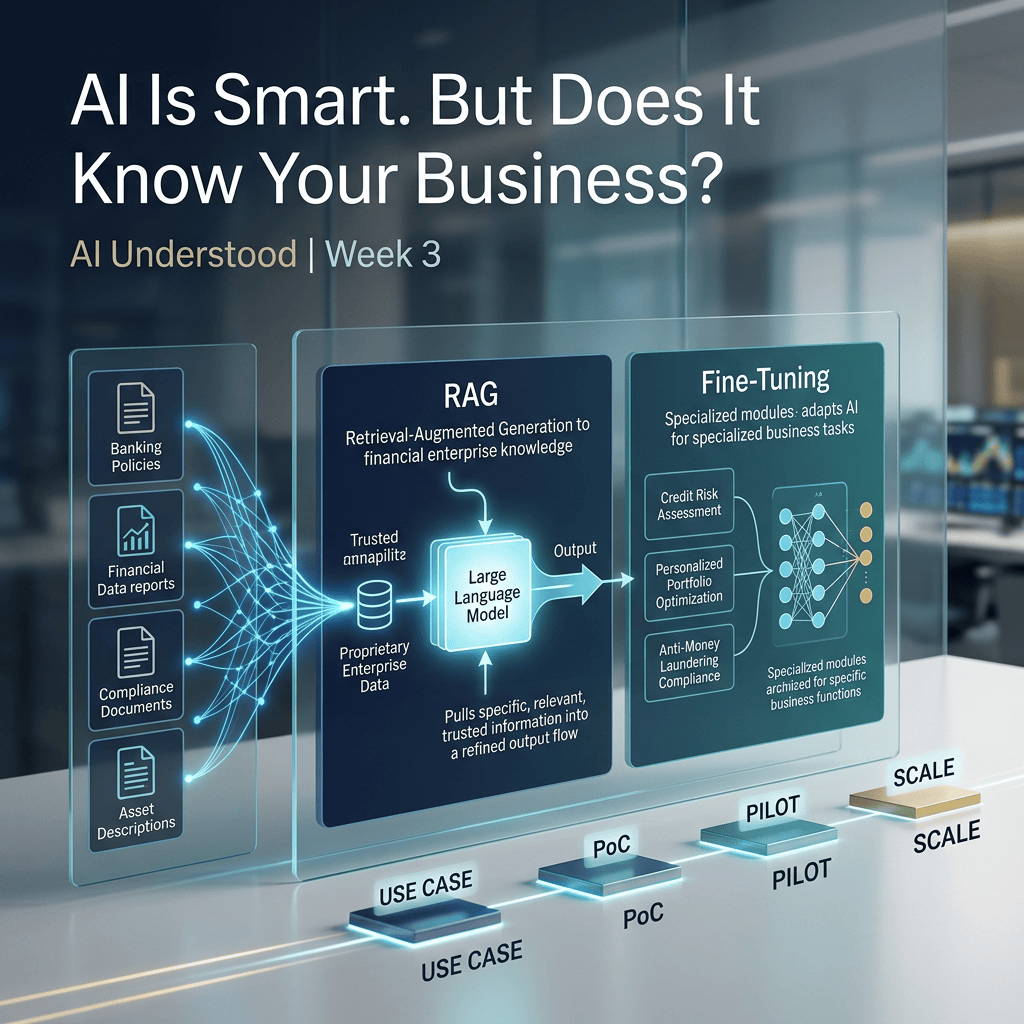
Last week, we explored how RAG and Fine-Tuning help AI access enterprise knowledge and perform specialized tasks.
But that raised another interesting question for me:
What if AI could do more than answer our questions? What if it could actually perform the work?
That’s where AI Agents and Agentic AI enter the picture.
From Answering Questions to Taking Actions
Imagine a Finance Manager asking an enterprise AI chatbot:
“Can you review this month’s management reports, identify significant variances, investigate the potential causes, and prepare a summary for my review?”
A traditional GenAI chatbot might explain variance analysis or summarize documents provided to it.
But an AI Agent, connected to authorized enterprise systems, could go further. It could retrieve financial reports, compare current and prior periods, investigate unusual movements, gather supporting evidence, and prepare a management summary.
AI is no longer just generating information. It’s helping execute business processes.
AI Agents vs. Agentic AI Workflows – What’s the Difference?
These terms are often used interchangeably, but there’s an important distinction.
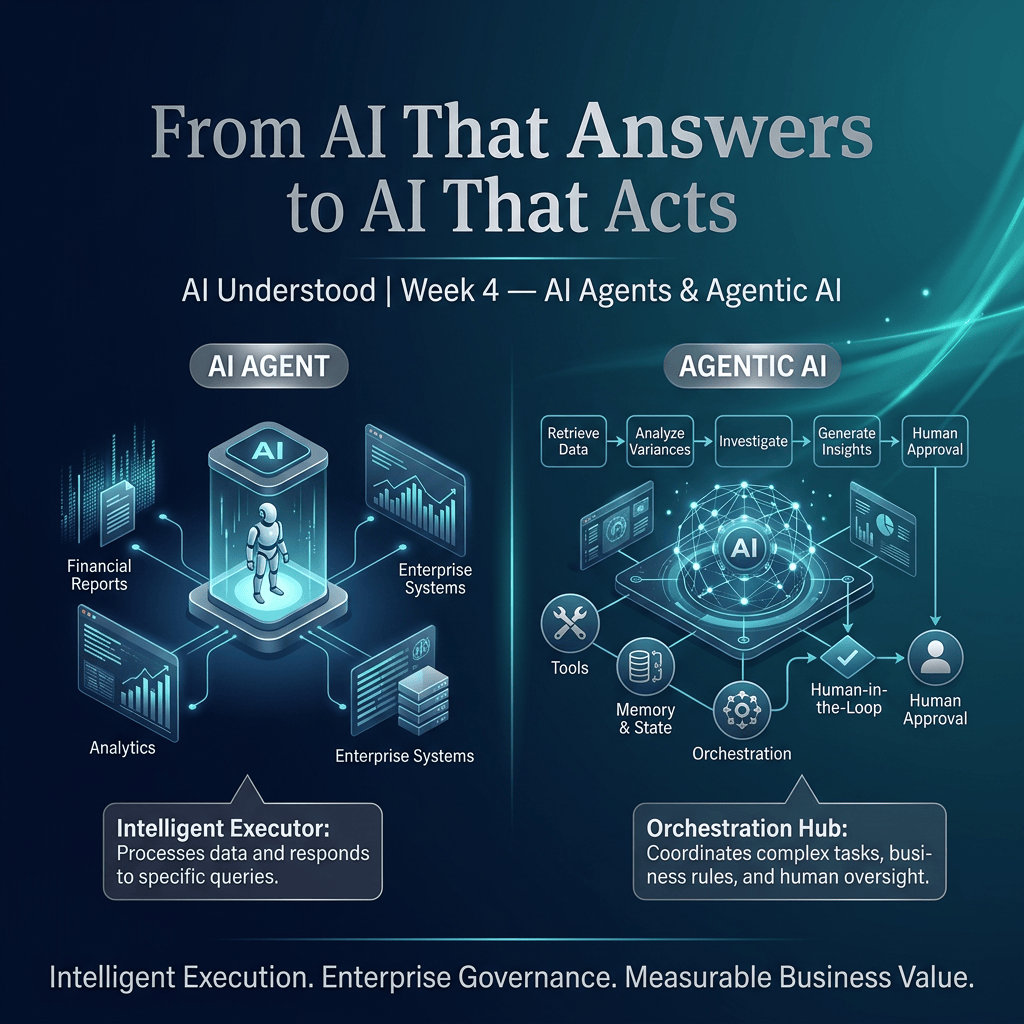
An AI Agent is an AI-powered component that can interpret a goal, decide what steps to take within defined boundaries, use available tools, and act on the results. An AI Agent is like an analyst capable of investigating a problem.
An Agentic AI Workflow coordinates AI-powered steps, tools, business rules, and sometimes multiple agents to complete a larger process. An Agentic Workflow is the operating process that coordinates the investigation, validation, escalation, and approval.
Not every workflow needs an autonomous agent. Sometimes a predictable, predefined process is safer and more effective.
What Makes Agentic AI Work?
Four capabilities help explain how these systems operate.
1. Tools – Giving AI the Ability to Act
An LLM alone cannot automatically access your organization’s financial systems. Tools and integrations allow an agent to interact with authorized databases, APIs, reporting platforms, and enterprise applications.
For example, an AI agent might retrieve approved financial data or initiate a reporting workflow.
2. Memory and State – Maintaining Context
Imagine investigating a $10 million variance across multiple reporting periods.
The agent needs to retain the reporting period, findings, completed steps, and outstanding questions.
Without appropriate context management, complex investigations can become inconsistent or repetitive. State tracks information during workflow execution. Memory can preserve relevant information across interactions when designed and permitted to do so.
3. Orchestration – Coordinating the Work
Who decides what happens next?
That’s the role of orchestration.
A workflow might follow:
Retrieve Reports → Analyze Variances → Investigate Exceptions → Generate Summary → Human Review
If a discrepancy exceeds a defined threshold, the workflow can branch into additional investigation or escalation.
Frameworks such as LangChain and LangGraph help developers organize these processes using stateful workflows, conditional branching, and controlled execution.
4. Human-in-the-Loop – Keeping People Accountable
This is particularly important in regulated industries. An agent might identify a reporting discrepancy and recommend an adjustment.
But should it independently change financial figures or approve the final report?
Not without the appropriate authorization and controls.
Human-in-the-loop mechanisms allow designated individuals to review findings, approve sensitive actions, and resolve exceptions.
The objective isn’t unrestricted autonomy. It’s controlled automation with clear accountability.
What Does This Mean for Enterprise Leaders?
Before introducing Agentic AI, I would ask five questions:
- Business Value: Which repetitive, multi-step process would benefit from automation?
- System Access: What enterprise tools and data should the agent be permitted to access?
- Reliability: How will we validate decisions, calculations, and generated outputs?
- Governance: Which actions require human approval, and how will we maintain audit trails?
- Value Realization: Are we improving cycle time, productivity, accuracy, and operational efficiency?
And the deployment approach remains:
Use Case → Proof of Concept → Pilot → Scale
Start with a manageable workflow. Prove technical feasibility. Pilot with controlled access and human oversight. Measure business outcomes before expanding.
My Biggest Takeaway
The evolution from Generative AI to Agentic AI is not simply about making AI more intelligent. It’s about making AI operationally useful.
But giving AI the ability to act also introduces responsibility.
For enterprises, success will depend on combining intelligent automation, reliable data, secure integrations, effective orchestration, and human accountability.
The goal isn’t to remove humans from the process. It’s to free them from repetitive work so they can focus on judgment, decisions, and higher-value activities.
Because ultimately, AI should accelerate business execution without compromising trust, control, or accountability.
Next Week: How do we design AI systems for different use cases that can coordinate multiple specialized agents to solve more complex enterprise problems?
#AIUnderstood #AgenticAI #AIAgents #EnterpriseAI #LangGraph #AITransformation #ResponsibleAI


Leave a Reply