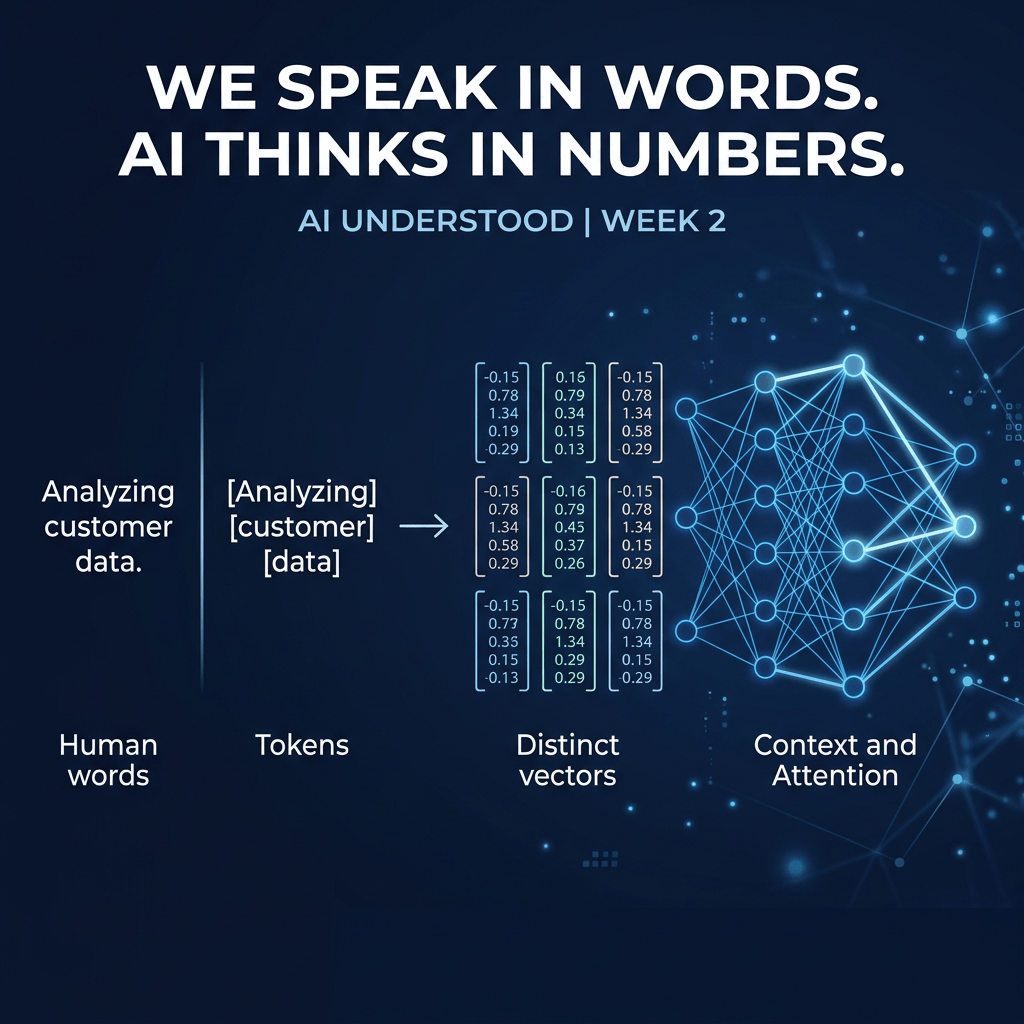
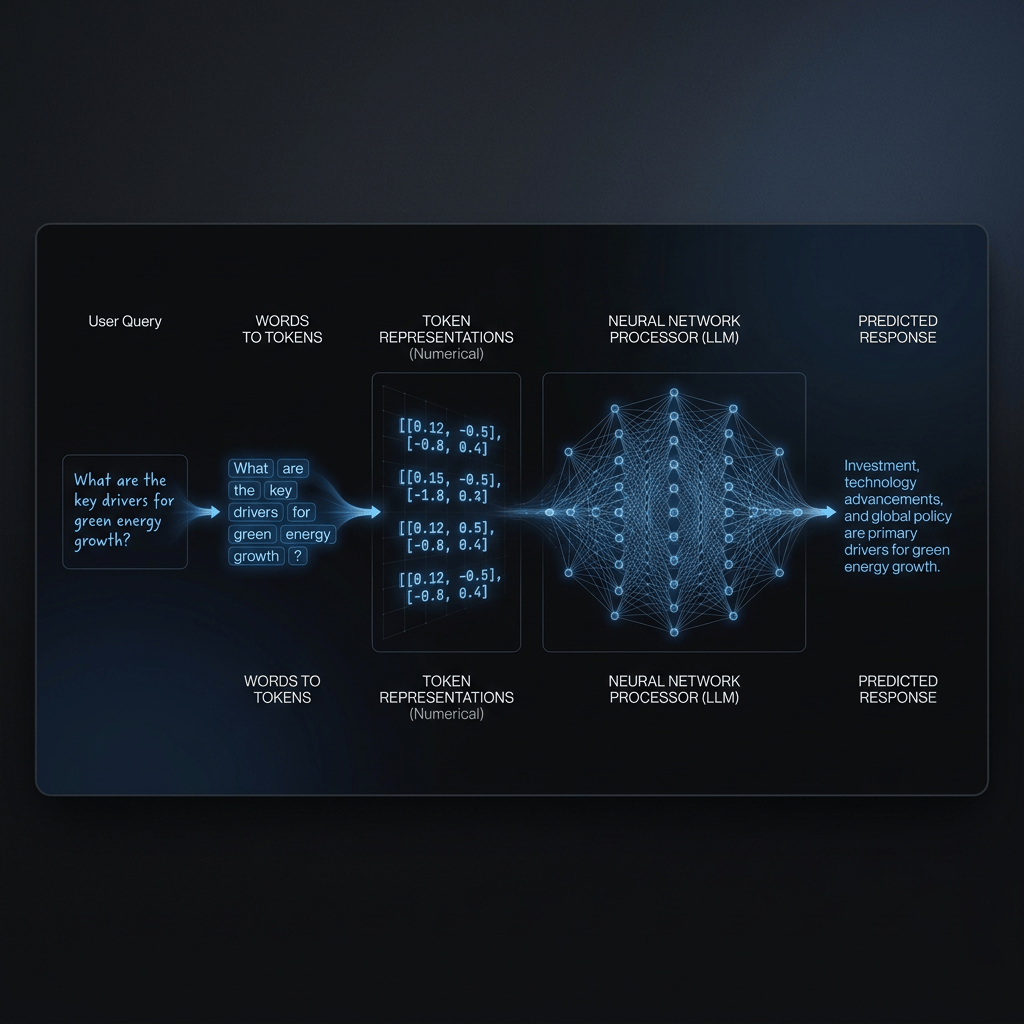
Last week, we explored how AI processes human language through Tokens, Embeddings, and Attention.
But understanding our language and understanding Organizational business are two very different things.
Imagine a commercial lending officer asking an AI assistant:
“Can we approve a $5 million commercial loan for this customer under our latest lending policies?”
Within seconds, Gen AI produces a confident, well-structured answer.
But here’s the real question.
Does AI know the bank’s latest credit policies, risk appetite, lending limits, and regulatory requirements?
Not necessarily. In financial services, a confident but incorrect answer isn’t just an inconvenience. It can become a financial, regulatory, or reputational risk.
So how do we make Generative AI more relevant, reliable, and useful within an enterprise?
Two concepts from my IBM Generative AI specialization help explain this: RAG and Fine-Tuning.
First, Why Does AI Sometimes Get Things Wrong?
Large Language Models (LLMs) learn patterns from enormous amounts of training data and generate responses based on those patterns.
But generating an answer doesn’t mean verifying its accuracy. When AI generates incorrect or fabricated information, we call it an AI Hallucination.
Imagine an AI assistant confidently quoting an outdated anti-money laundering (AML) procedure or inventing a regulatory requirement.The response may sound convincing, but acting on it could create serious consequences.
This brings us to our first solution.
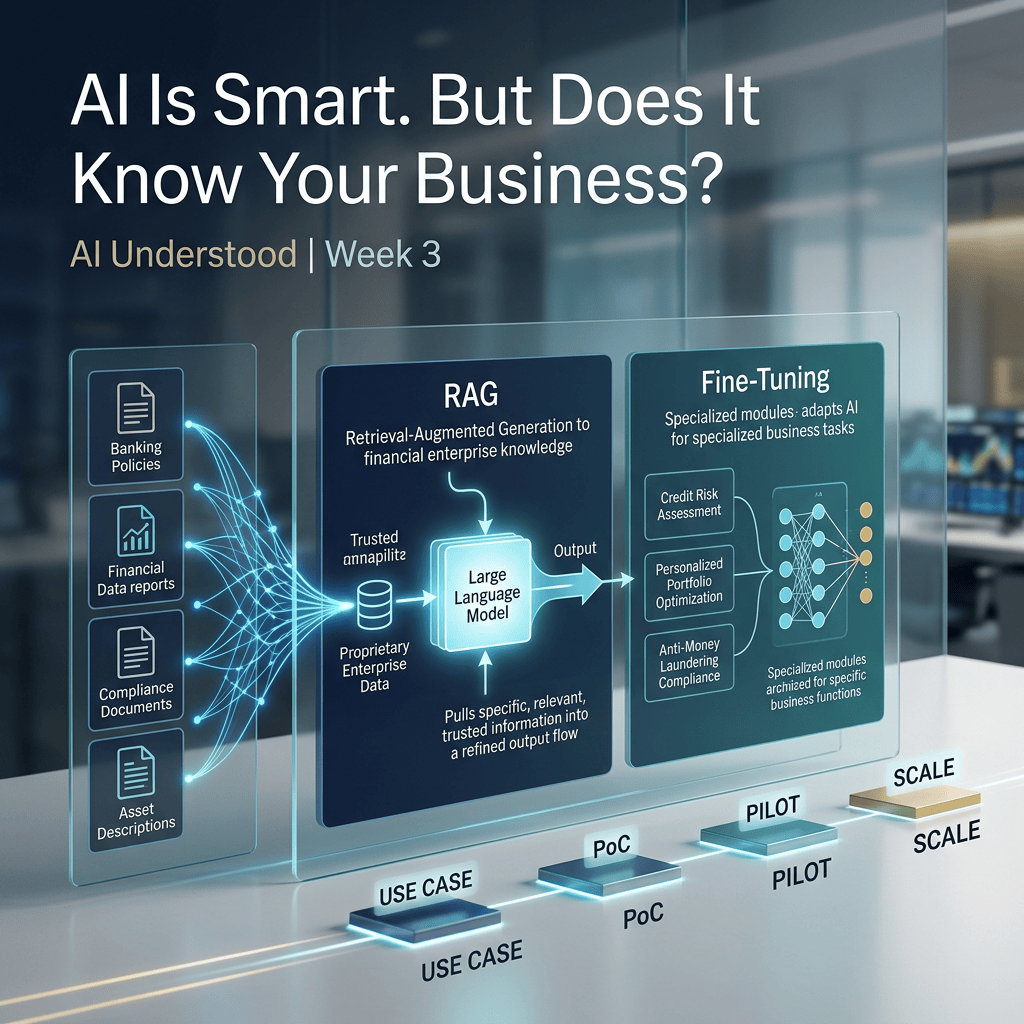
RAG – Connecting AI to Enterprise Knowledge
Retrieval-Augmented Generation (RAG) is simpler than it sounds.
Think of a newly hired banking professional who understands financial services but hasn’t memorized every internal policy. Instead of relying on memory, they consult the bank’s approved policies before answering a question.
RAG allows AI to do something similar.
Consider a relationship manager asking: “What are our current eligibility requirements for commercial real estate lending?”
A RAG-enabled AI system can:
- Retrieve relevant information from authorized lending policies and credit guidelines.
- Provide that information to the LLM as context.
- Generate an answer grounded in those documents, ideally with references.
Question → Retrieve Approved Policies → Provide Context → Generate Grounded Answer
The advantage?
When lending policies change, the bank can update its knowledge repository rather than retraining the entire model.
RAG can also support insurance policy inquiries, customer service, regulatory research, financial reporting, and internal compliance assistance.
However, RAG doesn’t guarantee accuracy. The retrieved information, permissions, and generated responses still require appropriate controls.
Fine-Tuning – Adapting AI to Specialized Financial Tasks
Now imagine an insurance company processing thousands of claims.
The AI has access to the latest policies but struggles to consistently classify claims into the company’s specialized categories.
Providing more documents may not solve the problem.
The model may need additional training.
That’s where Fine-Tuning comes in.
Fine-tuning further trains an existing model using carefully prepared examples to improve performance on specialized tasks.
For example, Enterprises might fine-tune models to:
- Classify claims using organization-specific categories.
- Categorize financial transactions according to specialized reporting requirements.
- Produce consistent financial risk summaries in approved formats.
The key distinction:
RAG gives AI access to relevant enterprise knowledge. Fine-Tuning adapts how AI performs specialized tasks.
And enterprises can combine both when necessary.
What Does This Actually Mean for Financial Services Enterprises?
Before investing heavily in GenAI, leaders should ask:
- Business Value: Are we improving lending turnaround time, claims processing, compliance productivity, or customer service?
- Data Readiness: Is our financial data accurate, governed, accessible, and appropriately protected?
- Architecture: Do we need current enterprise knowledge through RAG, specialized behavior through fine-tuning, or both?
- Risk & Governance: How will we validate outputs, enforce access controls, protect customer and enterprise information, and maintain auditability?
- Value Realization: Can we demonstrate measurable improvements in productivity, accuracy, cost, and customer experience?
From AI Experimentation to Enterprise Deployment
For Enterprises, successful AI transformation isn’t about deploying the most advanced model. It’s about solving the right business problem and demonstrating measurable value.
I believe enterprises should adopt a structured, value-driven AI deployment lifecycle:
Use Case → Proof of Concept (PoC) → Pilot → Scale
- Use Case: Identify a high-value business problem with measurable outcomes, such as reducing commercial loan processing time.
- Proof of Concept: Validate technical feasibility, data readiness, and whether RAG, fine-tuning, or another approach can solve the problem.
- Pilot: Test with a controlled group of users, measuring accuracy, productivity, adoption, risk, and business value.
- Scale: Expand across the enterprise only after demonstrating measurable results, operational readiness, and appropriate governance.
The principle is simple: Prove the technology works. Validate that it delivers business value. Then scale with confidence.
And throughout this journey, data governance, security, regulatory compliance, and human accountability must remain non-negotiable.
My Biggest Takeaway From My Learning Journey
Enterprises don’t need AI that knows everything. They need AI that can access the right information, perform the right tasks, and operate within the right controls.
Enterprise AI transformation should begin with business value and trusted data—not the latest AI model.Because the ultimate measure of AI success isn’t how intelligent the technology appears.
It’s how reliably it improves business outcomes without compromising trust, compliance, or accountability.
Next Week: What happens when AI moves beyond answering questions and starts executing tasks? Let’s explore AI Agents and Agentic AI.
#AIUnderstood #GenerativeAI #FinancialServices #EnterpriseAI #RAG #FineTuning #AITransformation #ResponsibleAI


Leave a Reply