Like many of us, I started using Generative AI before I truly understood what was happening behind the screen. I have extremely benefited from the help and support I received from Chat GPT and was also penalized for blindly accepting the responses without validating for biases and hallucinations.
Ask ChatGPT or Claude or Microsoft Co-pilot a question and, within seconds, you get a surprisingly coherent and the lengthiest answers.
It feels almost magical.
But as I started the IBM Generative AI Engineering with LLMs specialization, I realized something very different :
I actually saw the magic behind the scenes and understood what AI could do. I wanted to understand how it actually worked.
My career has largely been built around transformations, strategy and program / project leadership—not coding. I literally stayed away from coding for good 2 decades. So I decided to push myself outside my comfort zone.
I’m now getting hands-on with not only the concepts behind Generative AI, but also the code supporting processes such as tokenization, data loading, model training, fine-tuning, RAG and AI agents.
Not because I want to become a software engineer. I want to understand the technology deeply enough to connect what happens under the hood with what it means for the business.
And that’s why I started writing this series…. This will be 12 weeks series where I will be unleashing my learning and explaining the concepts in simple language. If I can’t explain what I’m learning simply, I probably don’t understand it well enough yet.
So let’s start with the question that started my curiosity.
So, What’s Really Happening?
Imagine typing:
“Why do companies struggle with digital transformation?”
We see a sentence.
The Large Language Model doesn’t see it quite the same way.
It doesn’t simply search a giant database, find an existing answer and return it.
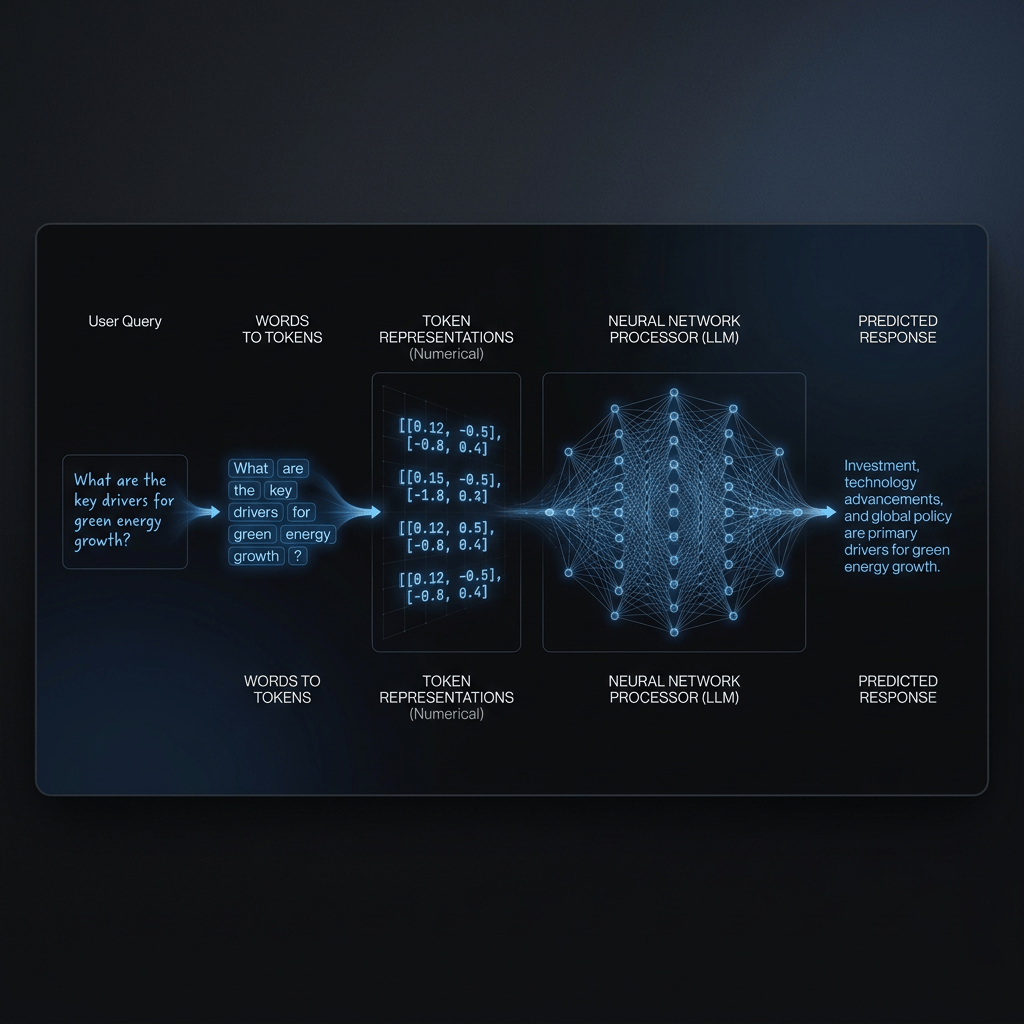
Instead, your sentence goes through several steps. It is broken into smaller pieces / tokens, converted into numerical representations in an array / vector format and processed through a neural network that has learned patterns from enormous amounts of text.
Then something fascinating happens.
The model starts predicting what should come next.
First, What Exactly Is an LLM?
A Large Language Model (LLM) is an AI model trained on huge amounts of text to learn patterns and relationships in language.
Think about the word “bank.”
If it appears alongside loan, customer, interest rate and deposit, you probably know we’re discussing a financial institution. If it appears alongside river, water and fishing, “bank” suddenly means something completely different. Humans understand this naturally.
LLMs learn these relationships mathematically by seeing language used across enormous numbers of contexts.
The Simplest Way I Could Make Sense of It
You’ve seen autocomplete on your phone.
Type:
“Thank you for your…”
Your phone might suggest:
“help.”
At its simplest level, an LLM does something conceptually similar—but at an extraordinary scale.
When you ask a question, the model generates a response piece by piece, repeatedly predicting what should come next based on your context and patterns it learned during training.
The mathematics underneath is obviously far more sophisticated.
But this mental model helped me:
An LLM generates language by repeatedly predicting what comes next.
This Is Where It Clicked for Me
Once I understood that, something else became clearer.
A confident AI answer doesn’t automatically mean a correct AI answer.
An LLM can be exceptionally good at producing plausible language. That’s powerful. But it also explains why AI can sometimes give us a beautifully written, confident answer that happens to be wrong. And this is where the conversation becomes much more interesting for businesses.
Now, Bring This Into the Real World
Imagine someone at a bank asks an AI assistant:
“What is our latest policy for approving this commercial loan?”
The LLM may understand banking extremely well.
But does it know your bank’s latest policy?
Was the policy part of its training?
Was it updated yesterday?
Does the AI even have access to it?
Suddenly, the question isn’t:
“How intelligent is our AI?”
It’s:
“Does our AI have the right information ? Can we trust its answer?”
That’s an entirely different problem. And later in this series, we’ll see how technologies such as RAG (Retrieval Augmented Generation) attempt to solve exactly this challenge.
Why Should a Business Leader / Executive Care?
Executives don’t need to become machine-learning engineers. But I increasingly believe leaders need enough AI literacy to ask better questions.
Where should we trust AI? What data should it access? How do we know its answer is grounded in reliable information? Where must humans remain accountable?
These aren’t simply technology questions.
They’re business and leadership questions.
What I’m Taking Away From This
My first major takeaway from going deeper into LLMs is surprisingly simple:
LLMs don’t pull perfect answers from a giant knowledge vault. They generate responses by predicting what comes next based on context and patterns learned during training.
But that created another question for me.
Before an LLM can understand my question, how does it actually read what I typed?
Turns out—it doesn’t quite see words the way we do.
It first breaks them apart into smaller chunks called TOKENS…
And that’s where things get interesting.
Next week:
Before AI Can Understand Your Data, It Has to Learn How to Read It — why tokens, tokenization and data preparation matter more than you might think.
#AIUnderstood #GenerativeAI #ArtificialIntelligence #AILiteracy #AILeadership #LargeLanguageModels #LLM #Transformers #RAG #AgenticAI #AIAgents #LangChain #FineTuning #NLP #MachineLearning




Leave a comment