![WE SPEAK IN WORDS. AI THINKS IN NUMBERS. AI UNDERSTOOD | WEEK 2. Analyzing customer data. [Analyzing] [customer] [data] → Human words, Tokens, Distinct vectors, Context and Attention.](https://chennupati108.com/wp-content/uploads/2026/10/an-insight-blog-my-perspectives-and-my-learnings-6ac7c3af3392d.png?w=1024)
Last week, I wrote about something that fundamentally changed how I think about Generative AI:
An LLM doesn’t retrieve a perfect answer from a giant knowledge data repository. It generates a response by repeatedly predicting what should come next.
That understanding immediately created another question for me.
If an AI model predicts the next word, how does it actually read the words I type?
The surprising answer?
AI neither reads the words nor understands the content that it is predicting. At least, not the way we do. Does it sounds confusing? Let me explain….
Humans See Words. AI Sees Tokens.
Imagine I type: “Generative AI is transforming businesses.”
I see five words with meaning.
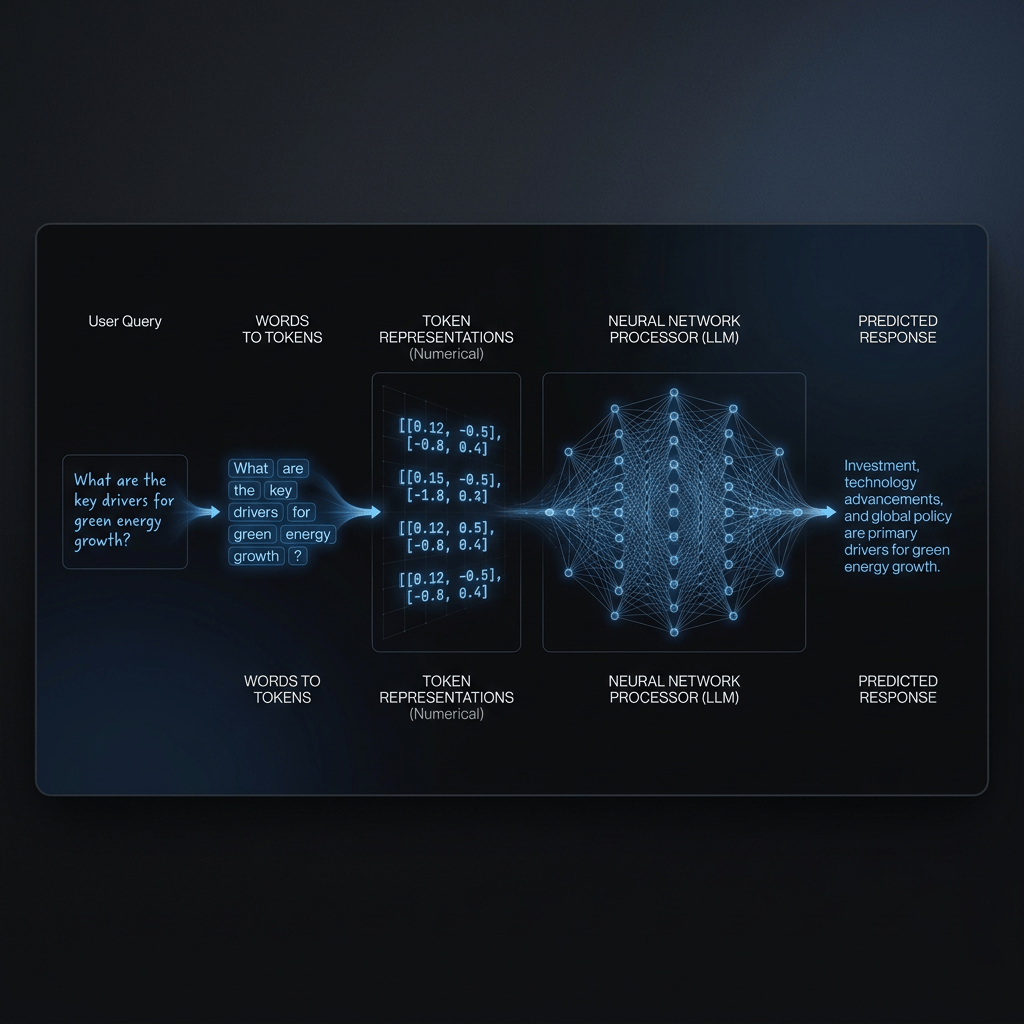
Before an LLM can process that sentence, it goes through something called Tokenization.
A tokenizer breaks text into smaller units called tokens. A token might be a whole word, part of a word, punctuation, or even spaces depending on the model.
Think of it like taking a sentence apart into LEGO pieces before rebuilding meaning from it.
But here is what surprised me during my IBM Generative AI Engineering specialization:
Even those tokens are not what the model ultimately understands.
Computers work with numbers. So each token gets mapped to a numerical ID. Those IDs are then transformed into mathematical representations called Embeddings — essentially coordinates that help the model represent relationships between pieces of language. The Embeddings are stored as numbers in Vectors.
Suddenly, language has become mathematics.
Why Does That Matter?
Consider these two sentences:
“The bank approved my loan.”
“We sat on the bank of the river.”
The word bank appears in both.
Yet you immediately understand that they mean completely different things. Modern language models use the surrounding context to build representations that help distinguish those meanings.
The ability to understand relationships between words and context is one reason LLMs can produce remarkably natural responses.
And it leads to one of the most important ideas I encountered in the course: Attention
Imagine sitting in an executive meeting.
Twenty people are talking, but when someone says:
“The program is six months behind schedule because the data migration failed.”
your brain immediately connects six months behind with data migration. You instinctively recognize which pieces of information matter to each other.
Transformers — the architecture behind most modern LLMs — use a mechanism called Attention to do something conceptually similar.
Attention allows the model to determine which parts of the input are most relevant when processing each token. And this happens across huge amounts of text and enormous numbers of mathematical calculations.
But There Is Another Important Lesson
What we give AI matters enormously.
During the specialization journey, I worked with tokenization, data loaders, model training, fine-tuning, transformers, RAG, LangChain and AI agents.
And one principle kept resurfacing:
The quality of an AI outcome is not determined by the model alone.
How information is prepared, structured, retrieved and provided as context can dramatically influence what the model produces.
That has significant implications for businesses.
Organizations can spend millions implementing sophisticated AI platforms, but if the underlying information is outdated, poorly governed, fragmented or inaccessible, a powerful model cannot magically repair the problem.
The success of AI depends upon the underlying data beneath the model. If the data is bad even the best AI model will not generate good results.
This Changed the Questions I Would Ask as a Leader
Earlier, I might have asked:
“Which AI model should we use?”
Now I would also ask:
- What information are we giving to the AI system?
- Where does that information come from?
- How current and reliable the data / information beneath the model?
- How much context can the model actually process?
- And how do we know the response is grounded in the right information?
Those are not engineering questions alone. They are business architecture, data governance, risk and leadership questions.
You don’t need to become a programmer to lead AI transformation. But leaders responsible for AI investments increasingly need to understand enough about how these systems work to challenge assumptions, recognize limitations and ask better questions.
Because once AI starts influencing customer decisions, employee decisions, financial decisions or operational decisions, “the Technology Team said it works” is simply not enough.
Next week, I want to tackle the next question my learning created:
If an LLM learns from enormous amounts of data, why does it still confidently get things wrong?
#AIUnderstood #GenerativeAI #AILiteracy #AILeadership #LLM #Tokenization #Transformers #Attention #ArtificialIntelligence #DigitalTransformation #ResponsibleAI




Leave a comment